
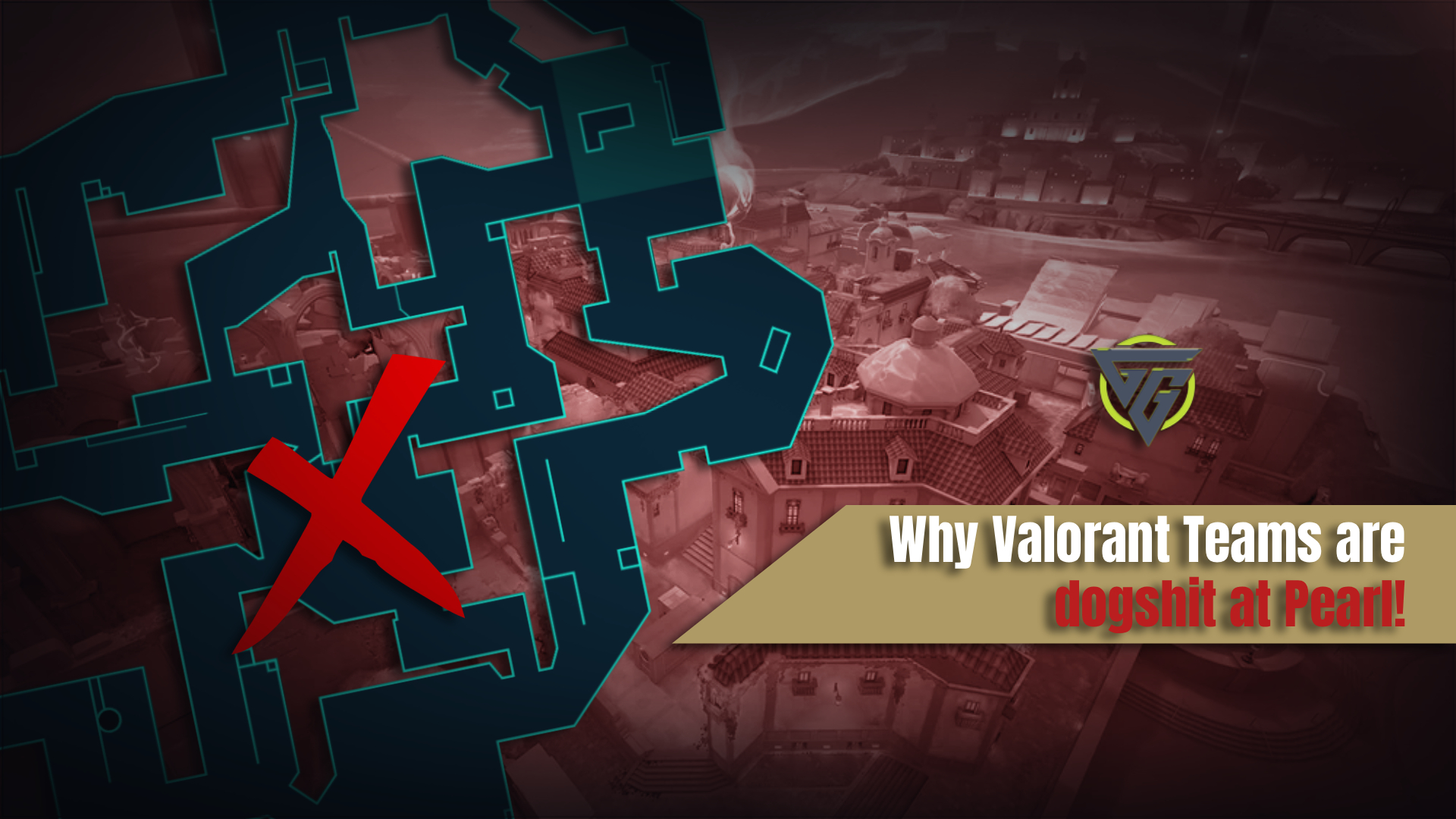
Why Valorant Teams are dogshit at Pearl!

Pearl has been part of the map pool long enough that there really shouldn't be any fundamental misunderstandings about its operation anymore. At this stage, its core identity is not an abstract or theoretical notion; it is clearly articulated through the way rounds consistently unfold at every level of the game.
This map is centered around applying pressure, denying defenders reliable information and compelling reactions across large areas of the map instead of isolating gameplay to one specific zone. This is not a debatable perspective; it is the foundational understanding of Pearl.
However, despite this clarity, a significant portion of the Valorant community still engages with the map in a manner that directly contradicts these principles. What makes this particularly concerning is that this issue does not originate in the lower tiers or ranked environments; it begins at the very top and then spreads downward.
A Tier 1 Problem that spreads downwards!
A significant portion of how Pearl is currently played across all tiers is heavily influenced by what is seen in VCT. In theory, this should raise the overall level of play, since teams are learning from the highest level available.
The issue is that Tier 1 is not consistently setting the right example.
What we often see are early round structures that prioritize mid control, with multiple players and utility invested into mid while key areas like B long are left largely uncontested. These setups look clean, they look structured, and they give the impression of control and flexibility.
However, when you actually analyze the impact they have on the round, they frequently fail to generate meaningful pressure on the defense.
Because these patterns are coming from Tier 1, they are rarely questioned. Instead, they are accepted as “correct” and replicated across the scene without much deeper thought.
The Copy-Paste problem across the Scene
As this method trickles down to Tier 2 and Tier 3 / GC, the problem becomes even more evident. Teams are not evolving or reinterpreting what they observe at the top level; instead, they are mimicking it as closely as they can. Often without grasping the rationale behind it or the circumstances in which it is meant to function.
This creates a scenario where the same mid-focused defaults are replicated everywhere, but in a weaker and less cohesive manner. The use of utilities becomes less accurate, timings are less polished and the overall framework loses whatever minimal effectiveness it initially possessed. Rather than cultivating their own comprehension of the map, teams depend on imitation, presuming that if something is executed at the highest level, it must inherently be the best approach.
The result is an ecosystem where flawed ideas are not only preserved but amplified.
EMEA’s Approach: Consistent, structured and fundamentally wrong
When comparing regions, EMEA stands out in a very specific way.
It is not just that EMEA teams use mid-prioritized defaults, it is that they commit to this approach more consistently and more rigidly than any other region. Early mid control is treated almost as a requirement rather than an option, with rounds repeatedly starting from the same structure regardless of opponent or context.
This creates a style that appears disciplined and methodical on the surface, but becomes highly predictable.
Even regions that are often criticized for weaker macro understanding, such as China, have shown more willingness to deviate from this pattern and explore alternative ways of approaching the map. In contrast, EMEA continues to rely heavily on a structure that limits its own ability to create pressure.
At that point, it is no longer just a stylistic preference; it becomes a refusal to adapt.
Why early Mid Control fails to create any pressure
The core issue with early mid control on Pearl is not that mid itself lacks value, but that taking it early without establishing pressure elsewhere removes one of the key factors that makes the map difficult to defend.
When attackers invest resources into mid while leaving B long uncontested, they effectively eliminate one of the main threats defenders need to account for. This has immediate and very practical consequences for how the defense can position itself.
Defenders can hold B with minimal investment, often committing a single player or relying on utility alone, while reallocating additional resources to other parts of the map. This makes early rotations safer, allows for more aggressive positioning and significantly reduces the number of variables defenders need to consider.
From the defensive perspective, the round becomes easier to read not because of exceptional decision-making, but because the attackers have removed complexity from the situation themselves.
By the time an execute happens, defenders are not reacting to pressure, they are simply responding to a limited set of predictable options. Same sort of pressure you would see in a ranked game.
Pressure as the Actual Win Con
In contrast; Teams that prioritize early presence in areas like B long operate under a fundamentally different understanding of the map. The goal is not necessarily to commit to a site immediately, but to force defenders into making decisions early in the round.
When B long is contested with multiple players and meaningful utility, defenders cannot ignore it. They are required to commit resources, invest utility and respect the possibility of continued pressure or a fast execution. Especially in the current bs meta. Thanks Riot Games for Patch 11.08 again!
This creates a chain reaction across the map. With defenders anchored on one side, rotations become slower, other areas become more vulnerable and attackers gain more freedom to reposition and adapt.
In this context, mid control becomes significantly more valuable, not because it was forced early, but because it becomes accessible as a result of pressure applied elsewhere.
Why are we talking about this in 2026?
The persistence of this issue is not due to a lack of information, but rather a lack of critical thinking.
Imitating established patterns is simpler than challenging them, and structured defaults offer a feeling of safety even if they aren't effective. When rounds do not succeed, it's easier to blame execution mistakes instead of reevaluating the foundational structure.
Nevertheless, if the initial phases of a round fail to generate pressure or provoke responses, the remainder of the round is fundamentally restricted. No level of mechanical proficiency or rehearsed execution can adequately make up for a setup that makes the game easier for the opponent.
Written by TriGG0r
Former Head Coach & Analyst. Helping players understand the game at a fundamental level.