
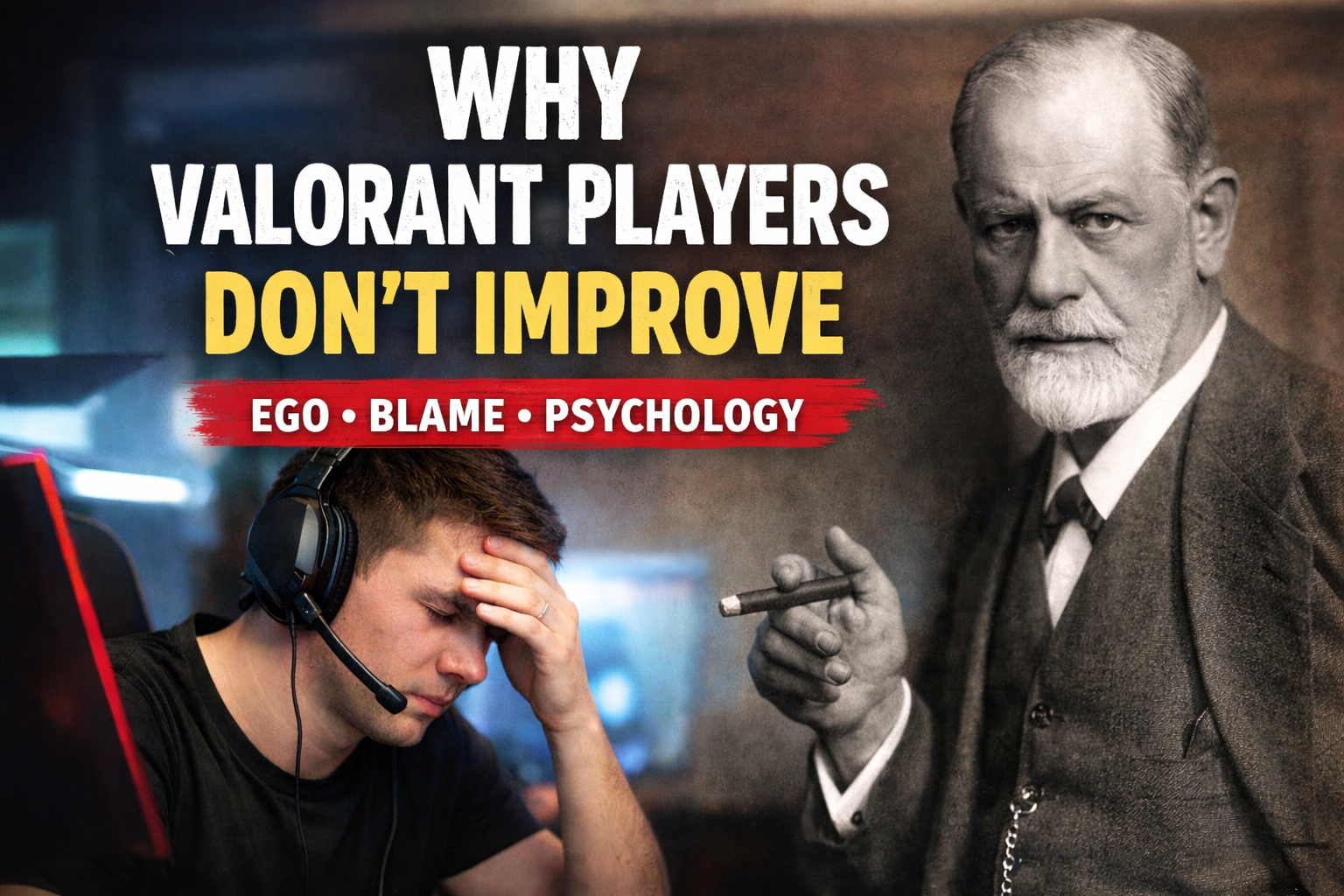
Why some Valorant Players NEVER improve!

A Coach’s Perspective Through the Lens of Freud
Sigmund Freud, the father of modern psychology, believed that complex, often unconscious forces drive the human mind. He described how our desires, ideals and sense of self constantly interact, sometimes in conflict. Freud argued that people naturally protect their ego, the part of the mind that defines who we are, from anything that feels threatening, such as failure or criticism. In simple terms, we often defend ourselves against our own mistakes rather than using them to grow.
In my years coaching Valorant players across different competitive levels, I’ve noticed how clearly these principles play out in gaming. Some players improve steadily over time while others remain stuck, no matter how many hours they put in. They grind ranked, they warm up, they watch content. And yet nothing truly changes. In most cases this stagnation isn’t about mechanics or talent. The real barrier is psychological. To understand why some players struggle to improve, it helps to see how Freud’s ideas about ego, self-protection and responsibility apply to competitive gaming.
When your Rank / Perfomance becomes your Identity
For many players, performance in Valorant is not just an external measure, it becomes part of who they are. Rank, statistics and impact are tightly connected to self-image. A good game feels validating, a bad game feels personal.
Instead of thinking, “I made a bad decision,” the internal message often becomes, “I am a bad player.” This distinction is critical. Freud described how humans instinctively protect their sense of self. When self-worth is built on performance, every mistake threatens that foundation. The mind doesn’t respond with calm analysis, it reacts defensively. And that is where real improvement begins to break down.
The internal conflict behind Mistakes
Freud described the psyche as a constant negotiation between desire, ideals and reality. In Valorant, this tension is visible in almost every match. One part of the player wants to win, dominate and feel competent, another part holds a rigid image of what a “good player” should be: consistent, confident, impactful, rarely wrong. Reality, however, does not cooperate. Valorant is chaotic, unpredictable and full of uncontrollable variables. When reality clashes with this ideal, the mind faces a choice: accept imperfection or reject responsibility. Many players choose the latter.
Why blame replaces reflection
Blaming teammates is often labeled as immaturity or toxicity. In reality, it is usually fear. Admitting a mistake honestly requires emotional stability, it means accepting that you’re not as good as you want to be yet. For players whose self-worth depends on being seen as competent, this feels threatening.
Freud would describe this as a defense mechanism. Responsibility is pushed outward to protect the inner self. The mistake belongs not to the player but to the call, the timing or the teammate. This gives short-term relief, the ego stays intact, but learning stops. Improvement only happens when responsibility remains internal.
As a coach, I have also noticed that even today, addressing mistakes in a calm and factual way can be quickly interpreted as toxic. Players or observers may feel personally attacked, even when the goal is simply to point out errors and encourage growth. This makes coaching honest reflection even more challenging because guiding someone can be misread as blame or hostility.
The Illusion of Self-Awareness
Another common barrier is the player who believes they are already self-aware. “I know my mistakes,” “I already see it,” “Reviews don’t help.” These statements often sound confident, but most of the time they are a form of avoidance.
True self-reflection is uncomfortable. It requires watching yourself fail without excuses and noticing patterns rather than isolated moments. For players with fragile self-images, this feels threatening rather than informative. Freud would say this is the mind prioritizing emotional safety over growth.
Why grinding Ranked alone doesn’t work / fix this issue
Many players respond to stagnation by playing more games, more ranked, more deathmatch, more hours. While volume matters, it cannot overcome avoidance. When mistakes are never fully acknowledged, they repeat. Habits solidify. Frustration grows. Players tilt more and learn less.
From a coaching perspective, this is one of the hardest barriers: a motivated player who is unwilling or unable to confront themselves honestly. Without that confrontation, effort becomes noise.
What actually enables Improvement
Players who improve consistently share one key trait: they separate performance from identity. A mistake does not define them, it informs them. They can say, “That was my fault” without shame, defensiveness or emotional collapse. Not because they are flawless, but because their self-worth does not depend on being flawless. Freud would describe this as a stable internal balance. Reality can be accepted without panic. Responsibility becomes possible and with responsibility, learning follows naturally.
How Players can work on this
Breaking this cycle begins with learning to tolerate discomfort. Most players already know what they do wrong on a surface level. The challenge is staying honest without immediately protecting the ego.
One effective step is changing how mistakes are verbalized. Players who struggle often describe errors defensively or avoid naming them clearly. Instead of thinking, “Yeah, but I had no info” or “It was unlucky,” it becomes: “I overextended,” “I misread the timing,” “I took a fight I didn’t need to take.” This keeps responsibility internal without turning it into self-judgment.
Reflection also requires slowing down. Rushing through reviews or moving on immediately after a loss is often a way to avoid discomfort. Staying with a mistake long enough to truly understand it is uncomfortable, but that discomfort is exactly where learning happens.
Positive self-talk is another essential tool. Negative internal dialogue like “I’m throwing” or “I always mess up” reinforces fear and triggers defensive behavior. Healthy self-talk does not ignore mistakes; it contextualizes them. It sounds like: “That decision didn’t work. I’ll adjust next round” or “I made a mistake. Stay focused.” This keeps the mind engaged rather than shutting down, allowing responsibility to become emotionally tolerable.
Honest Self-Reflection in Practice
To make self-reflection more genuine and structured, research suggests a few practical methods. Setting aside regular time to review games and decisions helps players notice patterns rather than just isolated events. Writing thoughts in a journal clarifies what actually happened versus what was felt, and provides a record to track progress. Asking open-ended questions like What led to this decision or What patterns do I see across games encourages deeper analysis. Mindfulness or short meditation sessions help observe thoughts without judgment and reduce defensive reactions. Finally, seeking feedback from trusted teammates or other coaches highlights blind spots and offers perspectives the player might miss.
Most Valorant players who never improve are not lazy, untalented or unwilling. They are stuck protecting an image of themselves that cannot survive honest reflection. Freud understood this long before competitive gaming existed. As long as people focus on defending who they think they are, they cannot become better than they are.
As a coach, my role goes beyond teaching setups, roles or strategy. It is about helping players face their own mistakes without fear, because that is the moment where real improvement begins.
Written by TriGG0r
Former Head Coach & Analyst. Helping players understand the game at a fundamental level.