
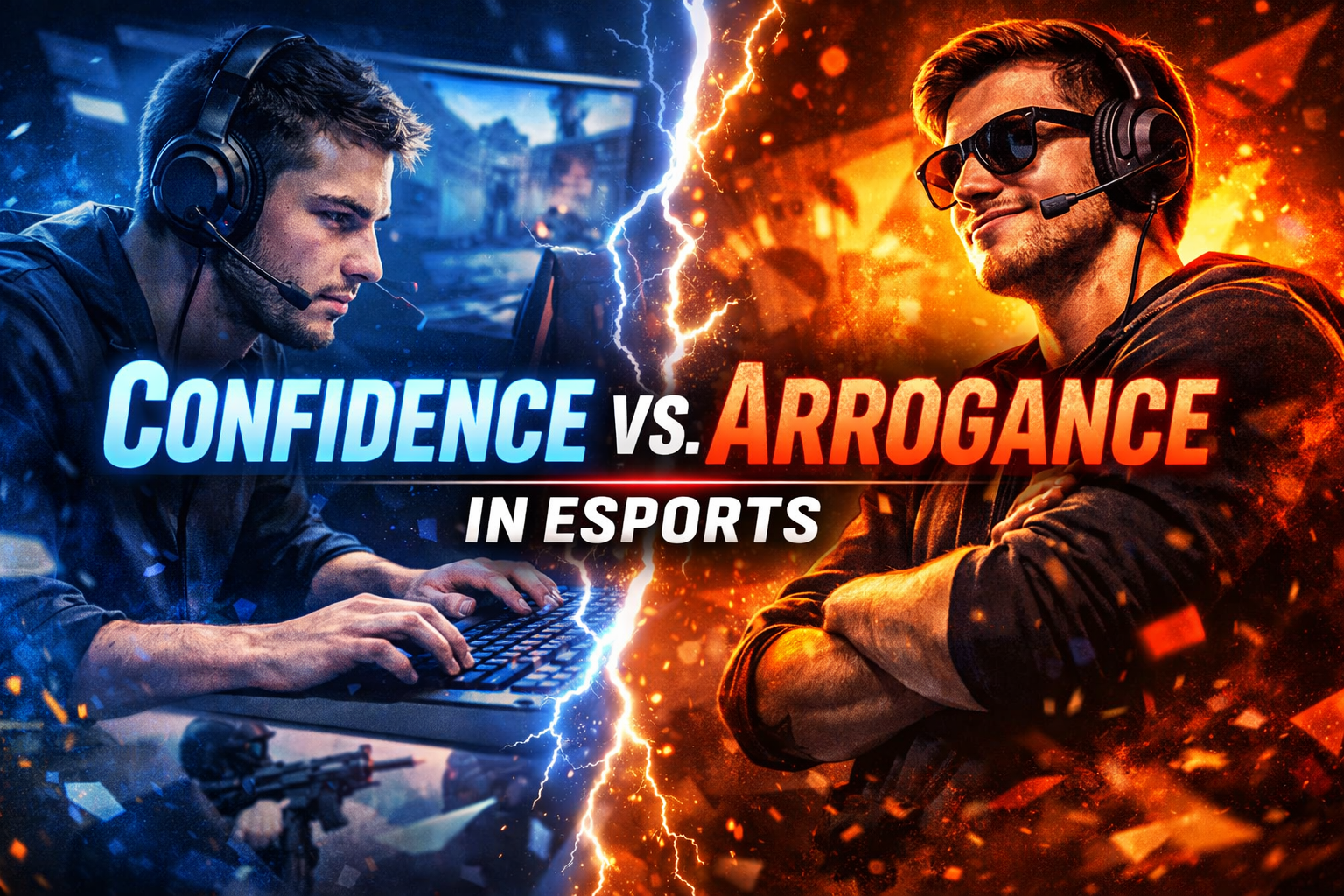
The Difference between Confidence and Arrogance in Esports

In esports, the phrase “don’t respect them” gets repeated constantly. It is usually meant as a way to boost confidence and remove hesitation before important moments. Players are encouraged to trust themselves, to take fights, and to avoid freezing under pressure. In the right context, this message can be helpful. It pushes people to act instead of overthinking.
Over time though, the meaning often becomes blurred. What starts as encouragement can slowly turn into something else entirely. Confidence gets mixed with arrogance. Awareness gets confused with ignoring information. The original intention gets lost in translation.
To really understand performance in competitive games, these ideas need to be separated again.
Confidence and Arrogance are not the same thing
Confidence is often misunderstood as loud or aggressive behavior. In reality, true confidence is stable and controlled. It does not depend on winning the last round or hitting a perfect shot. It exists even when things go wrong.
A confident player can lose a round and still make the correct read in the next one. They do not need everything to confirm their belief in themselves. Instead, their strength comes from experience, preparation, and the ability to stay mentally steady when situations become chaotic.
Arrogance works in a very different way. It creates expectations before the round even develops. When reality does not match those expectations, frustration appears. Instead of adapting, the focus shifts toward forcing the situation back into what was originally imagined. That is where mistakes begin to stack up, because attention moves away from what is actually happening in the game.
What actually happens in unusual Situations
Every player knows the feeling. Something happens in a round that does not make immediate sense. A timing feels strange. A push comes at an unexpected moment. A decision looks incorrect at first glance.
The natural reaction is often to dismiss it. It feels wrong, so it is labeled as wrong without deeper thought. In the moment, there is no time to fully analyze it, so the brain fills in the gap with an assumption.
The problem is that the round does not care about those assumptions. If a play works, it works within the rules of the game, regardless of how clean or logical it appears. Ignoring it does not change the outcome. It only creates blind spots that show up again later in similar situations.
This is where many players lose consistency. Not because they lack mechanical skill, but because they fail to register what actually happened properly.
Respect for the Game instead of the Opponent
When people talk about respect in this context, they often think about respecting the enemy team. That is not the real point. It is not about fear or giving opponents too much credit.
Respect here means respecting the game itself.
It means accepting that the game is always correct in what it allows. If something keeps working, there is a reason for it, even if that reason is not immediately clear. The responsibility is to understand it, not to deny it.
This mindset changes how players approach information. Instead of forcing the game to fit their expectations, they begin to adjust their expectations to fit the game.
Not every opponent plays in a structured or predictable way. Some players rely on habits that look random from the outside but are actually consistent in their own logic. Even if those decisions are not textbook correct, they still function within the match. Recognizing that is part of growing as a competitor.
Communication after the Round
This idea does not stop once the round is over. It continues in how players communicate with their team.
In every call, there is a choice. A player can describe the situation exactly as it happened, or they can reshape it slightly to feel more comfortable or less responsible. At first, this difference seems small. A detail gets left out. A timing gets described more softly. A mistake gets reframed without directly stating it.
Over time, these small changes accumulate. The team slowly builds a version of events that feels better rather than one that is fully accurate. The danger is that decisions in future rounds are then based on incomplete information.
Clear communication removes that problem. When situations are described honestly and simply, the team gains a shared understanding. There is no need to over explain or defend anything. The focus naturally moves toward what can be improved.
Adaptation over Expectation
There is a quote from Bruce Lee that fits this idea well. Adapt what is useful, reject what is useless, and add what is specifically your own.
This mindset is at the core of high level performance. It is not about holding onto fixed ideas. It is about constantly adjusting based on what the game presents in the moment.
Confidence supports this process. It allows players to stay open to new information without losing stability. It helps them respond instead of react emotionally. Arrogance resists this process because it tries to maintain control over how the game should behave.
The difference becomes clear over time. Confident players adjust quickly when something new appears. They recognize it, process it, and respond without hesitation. Players who rely on rigid expectations often repeat the same mistakes because they keep trying to force the game into a pattern that no longer applies.
Seeing the Game clearly
Improvement in esports is not only about mechanics or strategy knowledge. It is also about clarity. The ability to see what is actually happening, without filtering it through expectation, is what separates consistent performers from inconsistent ones.
Every round is new. Even if the map, agents, or setups are familiar, the exact situation has never existed before in the same way. Treating it as something already known limits how much can be learned from it.
The game rewards awareness over assumption. It rewards adaptation over prediction. And it rewards those who stay honest with what they see, even when it does not match what they expected.
The more clearly the game is seen, the better it can be played.
Written by TriGG0r
Former Head Coach & Analyst. Helping players understand the game at a fundamental level.