
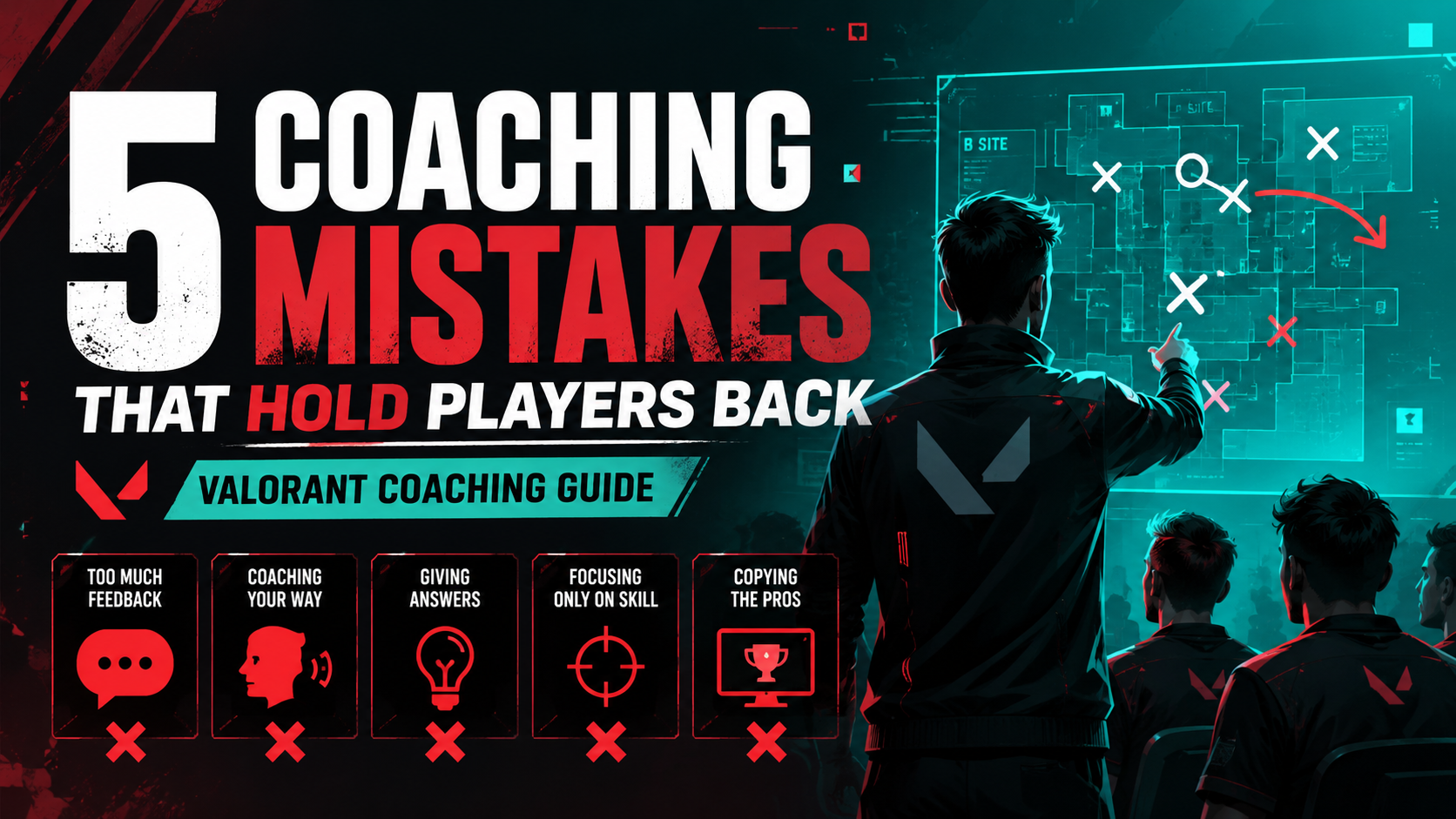
The Coaching Habits that quietly limits Player growth

When people think about bad coaching, they often imagine obvious mistakes: poor preparation, a lack of game knowledge or coaches who simply do not care about their players.
In reality, the habits that slow player development are usually much harder to spot.
They often come from a genuine desire to help. Coaches want to provide as much feedback as possible, solve problems quickly and share the lessons they have learned throughout their own competitive journey. The intention is positive, but the outcome is not always what they expect.
Over time, certain coaching habits can create dependence instead of growth, confusion instead of clarity and frustration instead of progress.
If your goal is to help players improve consistently and become more independent competitors, these are five habits worth paying attention to.
More Feedback does not always mean better Feedback
After a scrim block, most coaches can identify dozens of mistakes within minutes.
A player may have used utility inefficiently, missed opportunities to trade, communicated too late, positioned poorly during retakes or misunderstood the win condition of a round. The list grows quickly, especially when reviewing an entire match.
The temptation is to address all of it.
However, development does not happen because a player receives more information. Development happens when a player successfully applies information.
When every review session turns into a catalogue of mistakes, players often leave knowing they performed poorly but without a clear understanding of what should actually change first.
The most productive reviews are usually the simplest ones. Rather than attempting to solve every issue at once, identify the habits that repeatedly appear across multiple situations. Focus on the decisions that consistently influence outcomes.
A player who struggles with discipline during advantageous situations will continue to lose rounds regardless of how many utility mistakes are fixed. Addressing that underlying habit often creates far more improvement than discussing twenty smaller errors.
The objective of a review should not be to prove how much you noticed. It should be to provide a clear direction for improvement.
Your Players are not an Extension of yourself
Every coach views the game through the lens of their own experiences.
The way you communicate, process information, handle pressure and approach competition has been shaped by years of personal successes and failures. Naturally, those experiences influence the way you coach.
The challenge arises when personal preference begins to replace individual development.
A coach may value aggressive information gathering because it suited their own playstyle. Another may favour highly structured defaults because that approach brought them success. Neither approach is inherently wrong.
The problem occurs when players are expected to fit the coach's identity rather than develop their own.
Valorant is filled with successful players who approach the game differently. Some thrive through creativity and initiative, while others excel through patience and consistency. Effective coaching recognises these differences rather than attempting to eliminate them.
The best coaches spend less time asking, "How would I play this?" and more time asking, "How can this player succeed in their own way?"
That small shift in perspective can dramatically change the quality of your coaching.
The fastest Solution is rarely the best Teacher
One of the easiest ways to feel useful as a coach is to provide answers.
A player makes a mistake, you explain what should have happened, and the review moves forward. The issue appears solved.
Unfortunately, understanding a solution and being able to discover that solution independently are two very different skills.
During a match, players do not have a coach sitting beside them explaining every decision. They must recognise problems in real time and adapt accordingly.
That ability only develops when players are actively involved in the learning process.
Instead of immediately correcting mistakes, explore the situation with them. Encourage them to explain their reasoning, identify missing information and evaluate alternative options.
Sometimes players will arrive at the correct answer themselves. Other times they will not.
Both outcomes are valuable because they reveal how the player thinks.
The deeper your understanding of their decision-making process, the easier it becomes to coach the root cause of mistakes rather than repeatedly treating the symptoms.
Team Building starts long before the First Scrim
Many coaches invest significant time evaluating mechanical skill while paying relatively little attention to everything else.
Aim is easy to measure. Communication, attitude, resilience, and professionalism are not.
Yet those qualities often have a much greater impact on a team's long-term success.
A roster does not become successful simply because it contains talented individuals. It becomes successful because those individuals can work together through challenges, disagreements, losses and periods of slow improvement.
The strongest players are not always the best teammates.
When evaluating potential additions, pay attention to how they interact with others. Observe how they react when things go wrong. Consider whether their approach to practice aligns with the standards you want to establish.
Mechanical skill can elevate a roster's ceiling, but culture determines whether that ceiling is ever reached.
Building a healthy environment from the beginning is significantly easier than trying to repair a broken one later.
Stop copying what the Pros do and start understanding Why they do it!
The professional scene provides an endless source of ideas.
Every international event introduces new strategies, utility combinations, and approaches to the game. Watching elite teams compete can be incredibly valuable for both coaches and players.
However, one of the most common mistakes in amateur and semi-professional Valorant is confusing professional solutions with universal solutions.
Professional teams operate within systems that have been refined through thousands of hours of practice. Their communication standards, role understanding, and strategic depth allow them to execute ideas that would be unrealistic for most developing rosters.
Attempting to replicate those systems without the necessary foundation often leads to disappointment.
Instead of copying the strategy itself, focus on the principle behind it.
Ask what problem the professional team was trying to solve. Identify the reason the setup works. Then determine how that same principle could be applied within the capabilities of your own roster.
Coaching is not about recreating professional Valorant.
It is about helping your players play the best Valorant they are currently capable of playing.
Conclusion
Great coaching is rarely about saying more, teaching more, or controlling more.
More often, it is about creating clarity where players see confusion, providing direction without creating dependence and helping individuals grow into confident decision-makers.
The strongest coaches understand that player development is not a process that can be forced. It is a process that must be guided.
When players leave a session with a clear objective, a deeper understanding of their own decisions and the confidence to think for themselves, meaningful improvement becomes inevitable.
And ultimately, that is the true measure of effective coaching, not how much knowledge a coach possesses, but how much growth they are able to unlock in the people they lead.
Written by TriGG0r
Former Head Coach & Analyst. Helping players understand the game at a fundamental level.