How to train Fundamentals!

One of the biggest mistakes I see in Valorant, especially in Tier 3, is teams trying to shortcut improvement by copying Pro Play. They watch VCT, copy setups, comps, executes, and assume that will automatically make them better. What usually happens instead is frustration. The aim might be decent, sometimes even very good, but once they face teams with stronger fundamentals or simply better mechanics, everything falls apart.
Aim will always be important in Valorant, it's a shooter after all. It can win you rounds, sometimes even games. But aim alone does not create consistency. Fundamentals do. And when fundamentals are missing, teams often do not even realize why they are losing. They just feel stuck.
I have experienced this myself earlier in my coaching career. I joined a new team as a coach and quickly noticed that scrims had no real purpose. They were used to “test some stuff,” but those things were only tried once or twice per map. The rest of the game looked like ranked. No clear map control plans, no structured re-clears, no real retake practice, and not even basic execute fundamentals like leaving a chokepoint together as a unit. Everyone was playing, but nobody was really training.
That is the core issue. Scrims are treated as matches, not as practice.
Fundamentals are not flashy. They are repetitive, slow and sometimes boring. That is exactly why many teams avoid training them properly. But fundamentals are what allow teams to function under pressure. They are what make executes clean, retakes calm and mid-round decisions readable for everyone involved. It's is more or less your team's backbone!
The question is not whether fundamentals matter. The question is how to train them without wasting time.
The answer is structure and purpose. Fundamentals need to be isolated and trained intentionally. That often means dry exercises that focus on one scenario only. You can do these in scrims or even better in dedicated practice sessions, but they need clear rules and clear goals.
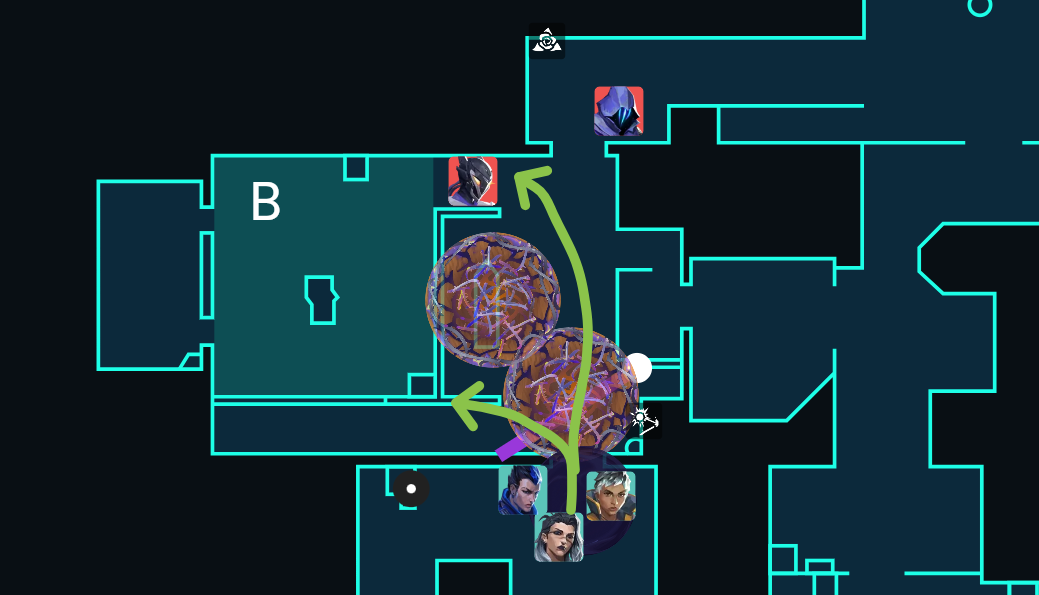
A simple example is training how to exit a chokepoint together during an execute. Instead of playing full rounds, you isolate the situation. You place one or two players on the defensive side (dedicated session only ofc). Their only job is to hold the entry chokepoint. They are allowed to use utility like smokes, mollies or flashes. The attacking side then repeatedly practices getting through that chokepoint as a unit.
The focus is not on winning the round. The focus is on how utility is layered, how players peek together, who clears which angle and how information is communicated before the execute even happens. Players learn how to combine their agents kit instead of acting individually. They also learn when to slow down, when to commit and when enough information has been gathered to go.
To keep everyone engaged and accountable, the first player who dies from the attacker side switches sides in the next repetition and becomes a defender. This continues until the defensive side no longer gets first bloods or stops the execute consistently.
One thing that cannot be ignored here is communication. Calls need to be clear, timely, and efficient. If communication breaks down in these drills, it will break down even harder in real matches and you have to work on them first.
Many teams avoid exercises like this because they take time and feel repetitive. Even teams at the highest level struggle with this. You can see it in VCT games when executes look disconnected or when teams fail to leave chokepoints cleanly. Fundamentals are often assumed instead of trained.
From my experience, that approach is a mistake. Teams I worked with improved their execute success rate by around 62 percent through consistent fundamental training. Nothing about the exercise was special or complex. The difference was repetition, structure and focus on 1 thing.
Consistency matters just as much as the exercise itself. The best results came from running these drills twice a week. Once at the start of the week to set the focus, then dedicating the next two scrims almost entirely to that theme and once again at the end of the week to reinforce what was learned.
It is important to stay on the same map for the entire week. Fundamentals improve faster when players recognize the same angles, timings and patterns. Maps should rotate weekly, not daily.
If a team wants to deepen the learning, working with two maps also works well. One map becomes the main focus of the week. The second map is the one from the previous week, used to reinforce and solidify what was already trained. This creates continuity instead of constantly resetting progress.
Copying Pro Play without understanding fundamentals is like building on unstable ground. Pro teams can play the way they do because their basics are deeply ingrained (or should be). Tier 3 teams usually do not lack ambition or effort, they lack structure and intentional practice.
Fundamentals are not exciting. They are not glamorous. But they are what separate teams that look good sometimes from teams that are good consistently. If scrims feel like ranked, that is not a player problem. That's a coaching problem!
And fundamentals are the fix, boring but the only real long-term solution.
Written by TriGG0r
Former Head Coach & Analyst. Helping players understand the game at a fundamental level.